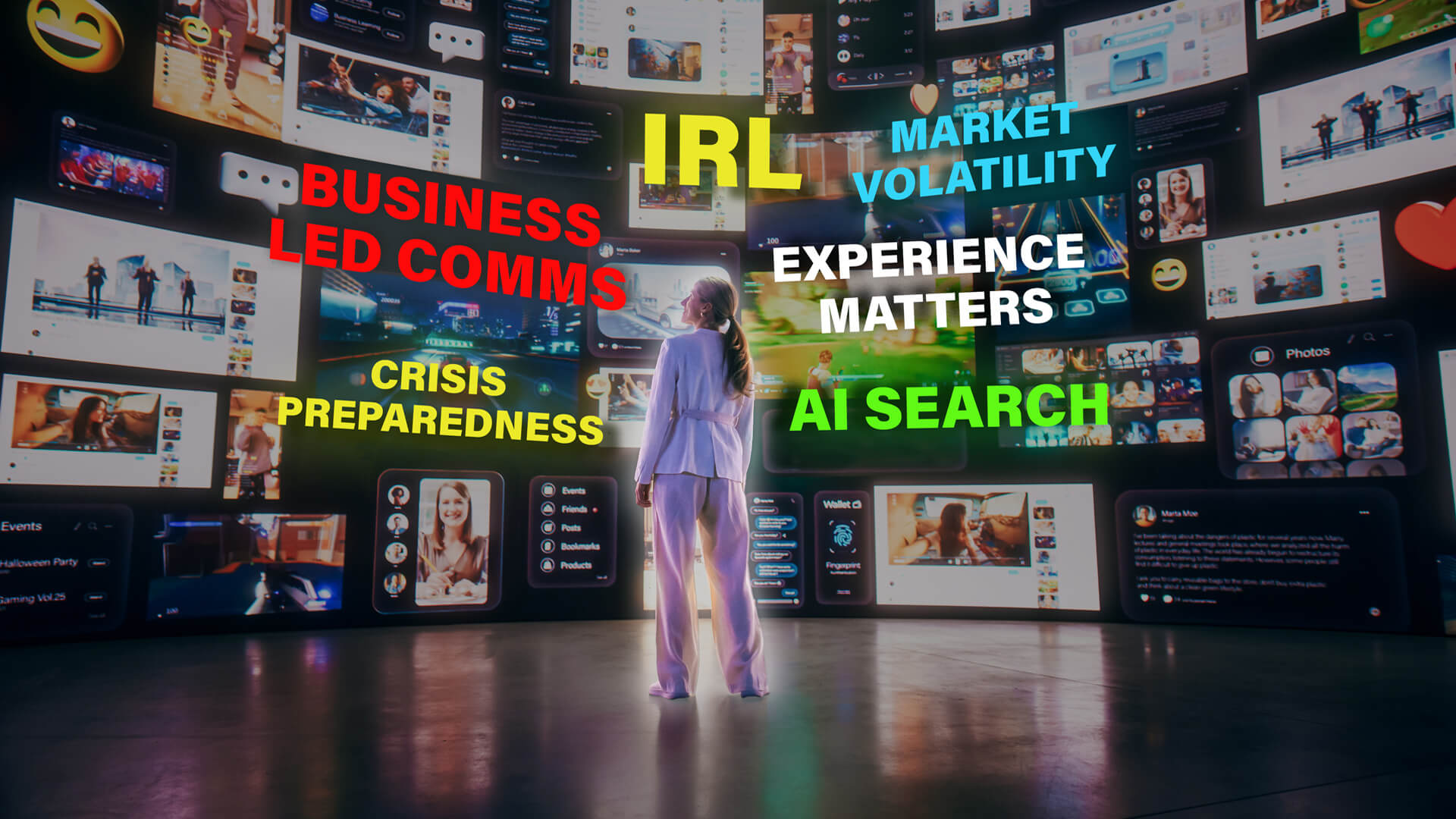
As we look to 2026, one thing is clear: the environment is moving faster and the stakes for getting communications right are higher. Markets are entering a new era of volatility, and leadership teams will expect steadier hands and clearer proof of business impact. Media and channels continue to fragment even as AI reshapes how people discover, evaluate and talk about brands, compressing the path from attention to action and accelerating the path from signal to crisis.
In this quarter’s Industry Sightlines, RF|Binder’s senior executives outline the shifts we see defining the year ahead and what leaders should do now to stay ahead of them. You’ll see a consistent throughline: the winners in 2026 will be the brands grounded in fundamentals – sharp strategy, real differentiation, disciplined messaging and credibility earned over time, while modernizing how they show up in the world.
That means anchoring communications more directly to business objectives, designing experiences that function as always-on cultural touchpoints and preparing for moments of market turbulence with proactive stakeholder communication. It also means meeting rising expectations in categories like healthcare, where affordability must sit alongside innovation, and treating AI-driven discovery as a foundational channel, not an experiment. Finally, as AI amplifies both opportunity and risk, leaders will need stronger monitoring and smarter scenario planning that connect communications to outcomes clients and stakeholders actually care about.
The perspectives that follow are designed to help you plan with clarity, move with speed and lead with confidence – no matter what 2026 throws at your brand.
_____________________________________
Rebecca Binder, President
Growth Starts with Business-led Communications
In 2026, the brands that grow will be the ones that start with business fundamentals and use communications as a lever to achieve them. The landscape will keep shifting – from media consolidation to rapidly emerging channels and new technologies (including AI) reshaping how content is created and distributed. But what will matter most is clarity on why you’re communicating at all: Why does your company exist? What are you trying to achieve right now? What is truly differentiated about your value, and what reputation do you need to earn to unlock growth?
Answering these fundamental questions is the foundation of effective communications. And to do this well, the same skills that have always been critical are required: sharp strategy, creative thinking, experienced judgment and the relationships that build trust over time.
Takeaway: As you plan for 2026, be curious about new channels and tools, and use them to execute well. But remember real impact will be rooted in translating your strategy, your differentiation and the reputation you need to earn into clear, creative, consistent storytelling wherever your audiences engage.
_____________________________________
Atalanta Rafferty, Senior Executive Managing Director and Head of Consumer
Experiences Become the New Center of Gravity in Consumer Communications
In 2026, consumer communications will be increasingly defined by the convergence of experiential and digital – where brand experiences are no longer episodic moments but cultural touchpoints that shape perception every day. As consumers prioritize experiences over ownership, they are seeking interactions that feel meaningful, participatory and reflective of their identities. For brands, this means the mandate has shifted: it is now necessary to create experiences that are not only memorable, but culturally fluent and directly tied to business goals.
The rise of hybrid experiential – “IRL” encounters amplified through digital content, community and personalization – will give communicators new levers to build relevance and impact. The most effective brands will anchor their strategies in insights about how their audiences live, socialize and express themselves, then design experiences that meet those motivations with intention.
Takeaway: In 2026, experiential isn’t an activation tactic, it’s a communications strategy. Brands win when they design culture-shaping experiences that move consumers and the business.
_____________________________________
Armel Leslie, Executive Managing Director, Financial Services
Volatility, Volatility, Volatility
While 2025 was certainly not ‘quiet’ in the capital markets ecosystem, the markets have fared okay (by time of publication), the serious drawdowns in crypto in Q4 notwithstanding. Expect 2026 to have sharper movements as the “risk off” trade may become prevalent given the interconnectedness of global markets (with bitcoin now in the mix), continued geopolitical issues and multi-year warnings that stock market valuations are frothy and the “AI trade” may lose its luster, for now.
Takeaway: Be proactive in communicating through downdrafts. Acknowledge bumps in the road but keep stakeholders, clients and end-users focused on the long game, based on the conviction they have as allocators and asset managers. For Fintechs, it is an opportune time to prove their mettle in helping clients navigate volatile markets via front-to-back solutions.
_____________________________________
Ted Deutsch, Executive Managing Director, Health & Life Sciences
Affordability Can’t Be Ignored in Healthcare Messaging
The default theme for healthcare companies across the spectrum has long been “innovation.” Walk into any pharmaceutical headquarters, for example, and you’ll be surrounded by dramatic words and images conveying the impact of innovation.
At the same time, the last two years in the U.S. political and media landscape have been marked by a focus on “affordability.” The issue arguably propelled President Donald Trump back into the White House and now hangs over his second term as a continued source of public dissatisfaction. The impact of rising costs spans all areas of the economy, including groceries, consumer goods and healthcare. That means smart players in the healthcare space must be attuned to affordability in their messaging.
While the U.S. Government has negotiated to lower more than 20 major drug prices, escalating healthcare premiums led directly to a government shut down. According to a report from American Hospital Association (AHA), total hospital expenses increased by 5.1% in 2024, well above the overall U.S. inflation rate of ~2.9%, which naturally impacts costs to payers, including consumers. An entire discipline exists – led by RF|Binder client ISPOR – to measure the value of new healthcare treatments and technologies to help make healthcare systems as effective and affordable as possible.
Takeaway: As we work with healthcare clients today, we counsel them to look for new ways to highlight their efforts to make their products and services not just breakthrough, but affordable. This doesn’t conflict with an emphasis on innovation. How that message unfolds depends upon each business, but it will resonate with customer, investor and regulator stakeholders. Signaling through clear communications that your organization is part of the affordability solution, not the problem, has never been more important.
_____________________________________
Kevin Duggan, Head of Paid & Digital
AI Search Matures from Experimental to Foundational
AI has reshaped every corner of marketing, but 2026 will be the year AI search becomes a fully established service category. As consumers shift from traditional search engines to generative AI platforms for recommendations, product discovery and decision support, these tools are beginning to mature the same way early search engines did. We’re already seeing the foundations: multimodal results that blend text, images and video, integrated ecommerce paths that shorten the distance between discovery and purchase, and the first waves of sponsored placements emerging inside AI assistants.
This matters because it formalizes AI search as a channel marketers can no longer treat as experimental. The rules are evolving, but the underlying drivers are clear. Platforms need sustainable business models, users want richer and faster answers, and brands want visibility in environments where customer journeys are becoming more compressed.
Takeaway: For organizations planning ahead, the takeaway is simple: treat AI search like an emerging but inevitable part of the media mix. Prioritize content that can perform across formats, invest in structured product data, understand how paid opportunities may surface and prepare for a future where AI-driven discovery becomes the default entry point for consumers.
_____________________________________
Will Maroni, Senior Managing Director, Research & Insights
AI Puts a New Spin on Crisis Communications
For communications leaders navigating delicate issues or outright crises, the evolving social and news media landscape continues to present a host of ‘interesting’ considerations. The proliferation of AI tools alongside the latest generation of bots and content algorithms often means that polarizing messages are pushed further and wider than ever, and that those messages are often increasingly removed from their original sources, making them more difficult to address.
Against this backdrop, one takeaway is that highly targeted monitoring and listening is more important than ever. Strategic communicators need to have their finger on the pulse of every rising conversation that could impact their brands, with clear lines of sight into the trajectory of those conversations, the audiences that they are likely to reach and the potential reputational fallout. Moreover, communicators navigating crisis scenarios need to bring a nuanced understanding of the new trajectory of hot-topic conversations to ensure the right level of response (or restraint). The fundamentals may remain the same, but certain key inflection points and channel- and tactic-specific best practices have shifted in the age of AI.
On the other side of the equation is the increasing value that AI has demonstrated in helping to navigate, minimize and avoid crisis scenarios. Communications strategists are increasingly leveraging AI for scenario planning and message testing, developing custom-built AI personas to help evaluate how different parties might respond to potential messages or events. Approaches like this enable crisis communications strategists to develop more effective messages, zero in on the communities and channels that matter most and ultimately improve their ability to protect their brands.