As RF|Binder celebrates its 25th anniversary, I have found myself reflecting on a question that feels increasingly important in today’s world: What creates value when everyone has access to the same information?
It is a question that has become especially relevant as artificial intelligence transforms how we work. AI can help us gather information, identify patterns, accelerate research, improve writing and perform countless tasks with remarkable speed and efficiency. These capabilities are extraordinary and will continue to reshape our profession.
But as technology becomes more powerful, I believe one human capability becomes even more valuable: judgment. And judgment begins with seeing. Not simply looking but truly seeing.
Lessons from Art and Photography
Long before I entered public relations, I thought photography might be my career. My father, David Finn, was one of the pioneers of the public relations industry, but he was also a renowned photographer of art and sculpture. Growing up, art was never something separate from my life. It was woven into it. I spent countless hours in his darkroom, learning photography from the ground up and later studying with respected photographers and taking courses at RISD while I was at Brown.
Photography taught me something that has stayed with me throughout my career: two people can look at the exactly the same thing and see something entirely different. Photography taught me patience as well as the importance of observation, and curiosity. It teaches us to notice what others might walk past. One of my favorite photographers, Minor White, captured this idea beautifully when he wrote: “No matter how slow the film, Spirit always stands still long enough for the photographer it has chosen.”
I have always loved that quote because it reminds us that seeing is not simply a technical act. It is a human one. What we notice, what captures our attention and what meaning we derive from it are shaped by our experiences, perspectives and curiosity.
Art as Part of Our Heritage
That connection between art, observation and perspective has shaped not only my own career, but also the culture of RF|Binder. At Ruder Finn, my father’s photographs and paintings lined the walls of our offices, serving as a daily reminder that seeing the world from different perspectives is essential to both art and communications.
We have carried that tradition forward at RF|Binder. Art is not there simply to make our offices a more interesting environment in which to work. It reminds us every day that seeing from multiple perspectives is fundamental to creativity, strategic thinking and better decision making.
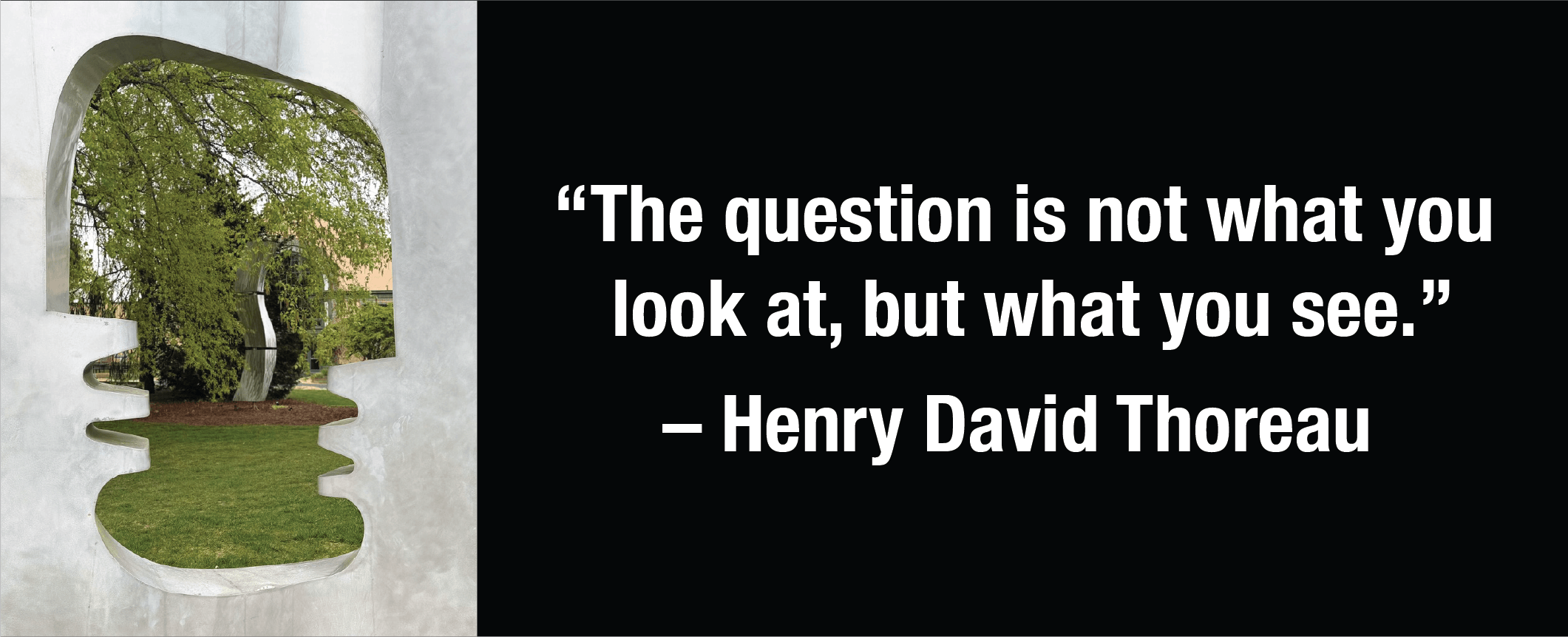
In our offices, my father’s watercolor paintings of trees hang alongside his photographs of sculpture, many capturing the same work from different angles. Our conference rooms, including Calder and Moore, reflect this heritage. So do my father’s “conference quotes,” which paired photographs of sculpture with quotations meant to inspire reflection and discussion. As part of our 25th anniversary, we are continuing that tradition by launching a new RF|Binder series of conference quotes. Like my father’s originals, they are intended to remind us that great ideas often come from looking at familiar things in unfamiliar ways.
The Business Value of Seeing
Every day, organizations face increasingly complex challenges. They are navigating change, managing risk, identifying opportunities and making decisions in environments filled with uncertainty. Information matters. Research matters. Data matters. But information alone rarely provides the answer.
The best decisions often come from recognizing something others have missed. They come from understanding multiple perspectives, identifying patterns and making meaning out of complexity. Those are deeply human skills.
In our profession, clients do not simply hire us to present information. They hire us to help them understand what matters, what is changing, what different stakeholders are thinking and how they should respond. That requires judgment. And judgment requires the ability to see beyond the obvious.
Communications as a Business Function
My belief in the value of perspective extends beyond communications itself. When I was earning my MBA at Columbia Business School, I was struck by how rarely communications and public relations were discussed. That never made sense to me. Organizations can have the best strategy in the world, but if they cannot build understanding, trust, engagement and support among the people who matter most, even the best strategy can fail.
Years later, conversations with my daughter Rebecca, now RF|Binder’s President, reinforced that belief. Through her work at Booz Allen and Innosight helping organizations rethink business models, transform operations and develop growth strategies, she often saw communications treated as something that came after strategy, rather than as part of how change would be achieved.
That approach always felt incomplete. Organizations do not change simply because a strategy exists. They change when people understand it, believe in it and act on it. That is why communications is not a supporting function. It is a critical business function. Whether an organization is navigating transformation, entering new markets, managing disruption or responding to emerging opportunities, communications plays a central role in helping leaders achieve business objectives. Communications is where strategy meets execution, ideas become action and plans become results.
A Principle That Shaped Our Firm
When RF|Binder was founded in 2001, we built the firm around a simple belief: organizations should structure themselves around the needs of clients, not around internal silos. At the time, many agencies operated in ways that made sense internally but often created complexity for clients. We believed there was a better approach, one that brought together diverse expertise and perspectives around a client’s business challenges.
That belief shaped the culture, values and client-first mindset established by the small group of colleagues who helped launch the firm, and it continues to define us today. Our integrated teams are built on the idea that better solutions emerge when people bring different experiences, backgrounds, disciplines and viewpoints to the table. Whether in narrative development or the channels we tap to bring a client’s messages to key stakeholders, the goal is the same: to understand the challenge from multiple angles and develop solutions that create meaningful business impact. We have embedded this approach into our firm’s culture and one of our guiding principles is the importance of viewing problems and solutions from multiple perspectives.
Over the past 25 years, every major technological shift has reshaped our industry. The internet, social media, mobile technology, and now AI, have all changed how communications works. Yet through every wave of change, one thing has remained constant: the value we provide our clients is the judgment and perspective we bring to every challenge.
Why Human Perspective Matters More Than Ever
As AI becomes increasingly capable, some have questioned what role human expertise will play in the future. I see it differently. The more information becomes available, the more valuable interpretation becomes. The more automation advances, the more important judgment becomes. The more answers technology can generate, the more important it becomes to ask the right questions.
Success has always depended on understanding different perspectives. It comes from listening carefully, challenging assumptions and recognizing that people with different backgrounds and experiences often see the same situation in very different ways.
That ability to see differently is one of the most valuable skills any leader can develop. It is also one of the most valuable capabilities organizations can cultivate.
Looking Ahead
As we celebrate 25 years of RF|Binder, I am incredibly proud of the clients we have served, the work we have accomplished and the extraordinary people who have helped build this firm. What is equally exciting is what lies ahead.
The next 25 years will undoubtedly bring changes we cannot fully predict. New technologies will emerge. Industries will evolve. The pace of change will continue to accelerate. What will not change is the need for thoughtful people who can navigate complexity, connect ideas, understand human behavior and exercise sound judgment.
Perhaps that is why, 25 years later, the artwork hanging in our offices still feels so relevant. Every photograph, every painting and every sculpture reminds us that there is always another perspective waiting to be discovered.
Marcel Proust once wrote, “The real voyage of discovery consists not in seeking new landscapes, but in having new eyes.” In an age defined by technological advancement, that idea may be more important than ever. The future belongs not simply to those with access to information, but to those who can interpret it wisely, understand people deeply and turn insight into action. What matters is not simply what is in front of us, but what we are able to see. That is where judgment matters. That is where communications creates value. And that is where the ability to see differently will continue to make all the difference.
As I reflect on our first 25 years, I am deeply grateful to every client, colleague, alum and partner who has helped shape RF|Binder. I look forward to seeing what we will discover together over the next 25 years.